


As you will recall, the view of many is that enterprise bargaining in Australia has run its course. Essentially the view is that there’s little incentive for an employer to bargain (beyond avoiding harm to the business through a tumultuous bargaining campaign) nor for employees who, for some time, have only managed to extract very modest pay increases.
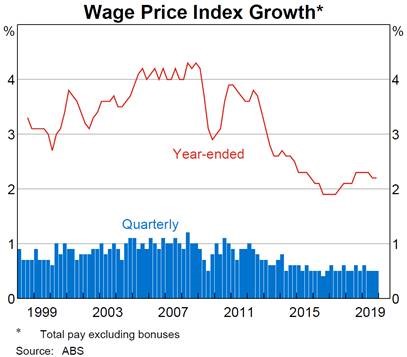
Modest wage growth has been a feature for some years as shown below (and note, by the way, the post GFC period 2008-2010).
The trend is similar under enterprise bargaining outcomes as the following reveals (with the 2019 growth similarly remaining flat).
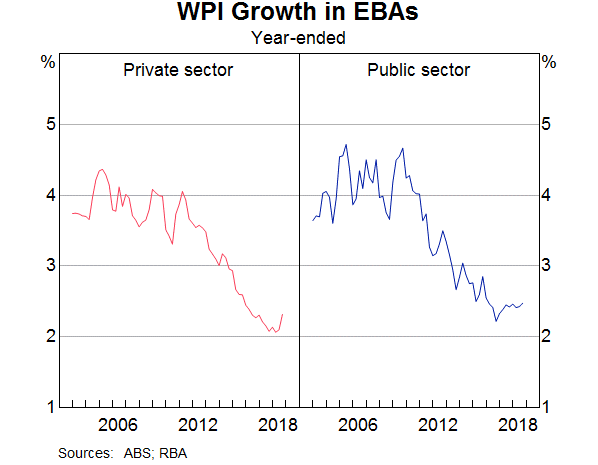
Pre COVID-19, there has been various commentary about the reasons for low wage growth with the best analysis recognising this as a worldwide phenomenon.
And now the wage outlook is worse. As the Governor of the Reserve Bank, Philip Lowe, recently stated, “With many firms delaying or cancelling wage increases, year-ended wage growth is expected to decline to below 2 per cent.”
Having worked with employers during and following the GFC, we can readily discern the following impact on enterprise bargaining:
- Bargaining will be stifled: there’s no or little cash out there in the private sector. So claims for job security for nominal wage outcomes will be common.
- Or not stifled: where a modest pay increase is agreed on a quick “rollover basis”.
- Short deals: particularly in the roll-over scenario. Single year deals will be seen again and often reached, informal MOU/agreements to continue the status quo.
- Variations to enterprise agreements: we’re seeing this now. Where employers are paying comfortably above award rates, some employers are looking for employee support to avoid the next wage increase.
- Terminations of agreements: less common, but for employers in distress, an option they’ll consider.
- Refusals to bargain: by employers, for obvious reasons.
- Co-operation: for a time, a greater willingness in some areas and by some unions to work in a genuinely collaborative way to ensure business and in-turn job survival.
Clearly, enterprise bargaining in the new world will be different for many. Accordingly, new thinking must follow.
Subscribe to receive the next Workplace Law & Strategy blog direct to your inbox.