


Link to Critical U.S Industry Depends on the PTAB – Not China Critical U.S Industry Depends on the PTAB – Not China
The so-called PREVAIL Act (here) was floated some weeks back to “to ensure the United States does not cede technological supremacy to our foreign competitors and adversaries.” As the accompanying materials insist, fighting China is the rationale behind the bill’s proposed patent reforms. That is, the U.S. Patent system must be made stronger to rival the Chinese threat by weakening the USPTO’s Patent Trial & Appeal Board (PTAB).
If this “stronger patents” argument sounds familiar, it should. Before its reinvention as the Prevail Act, the same “litigation first” ideas were packaged to the American public as the so-called Stronger Patents Act. But, the “Stronger” Bill went absolutely nowhere despite being introduced every year for the past six years (maybe 7, I lost count).
Not surprisingly, increasing patent litigation expense and unnecessary liability for successful U.S companies in the name of “stronger patents” didn’t resonate on the Hill. This is because the America Invents Act (AIA), which created PTAB trial was passed into law a little more than a decade ago for the purpose of reducing wasteful litigation over improvidently issued patents— and is working exactly as intended. Few legislators (aside from sponsors) were interested in a proposal to effectively repeal the AIA. So, after years of failure, this perennially failed effort has been newly-minted as the PREVAIL Act.
While the new spin also argues for stronger patents, it presents the need as a necessary tool to “prevail” against the growing technological threat from communist China. Ironically, the blatant dishonesty of this new spin only serves to highlight the critical importance of the PTAB to U.S. interests.
First, aside from the fear mongering and patriotic platitudes of the PREVAIL Act, you will find little substantiation of its claims that the PTAB forms any part of the equation with China; just the empty mantra “China Bad so PTAB Bad.”
Why are there no statistics on the overwhelming use of the PTAB by China and the countless Americans robbed of their technology by evil communists? Answer: Because no such data exists. The PTAB is overwhelmingly relied upon by U.S. companies to fight home-grown profiteers.
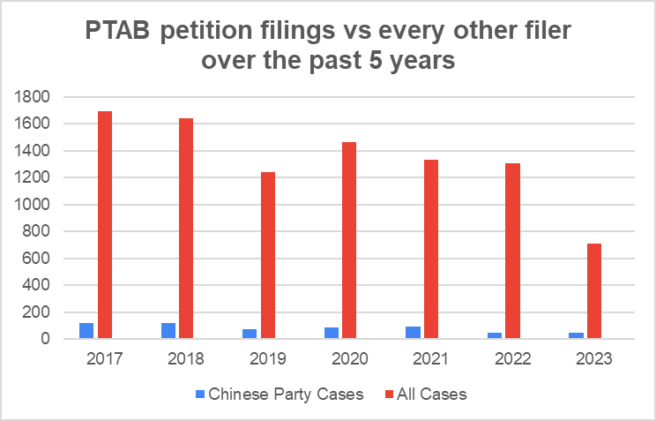
China has NEVER been a major filer of PTAB challenges. Chinese petitioners have averaged about 5% of PTAB filings per year since the inception of the Board (only the past 5 years are shown – special thanks to Docket Navigator for the study results)
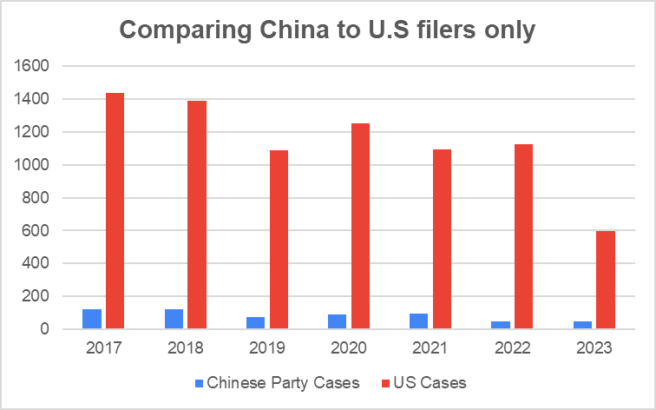
Comparing Chinese filers to U.S. filers highlights the true PTAB beneficiaries. Successful U.S. companies.
If you drill down further into these numbers, you will find that even the 5% of Chinese filings aren’t what they seem. The table (below) shows the top 20 PTAB petitioners of 2022. You will notice a single Chinese filer, EVE Energy, barely making the list at (#20). But, those petition filings were challenging the patents of a German based battery manufacturer, VARTA. The PTAB is simply not aiding China in any meaningful regard to the detriment of U.S. patent holders.
| Apple Inc. | California |
| Samsung Electronics Co., Ltd. | South Korea |
| Google LLC | Delaware |
| Samsung Electronics America, Inc. f/k/a Samsung Telecommunications America LLC | New York |
| Amazon.com, Inc. | Delaware |
| Meta Platforms, Inc. f/k/a Facebook, Inc. | Delaware |
| Microsoft Corporation | Washington |
| Roku, Inc. | California |
| Volkswagen Group of America, Inc. | New Jersey |
| Amazon.com Services LLC | Delaware |
| Amazon Web Services, Inc. | Delaware |
| DK Crown Holdings Inc. f/k/a DraftKings Inc. | Delaware |
| Dell Inc. | Delaware |
| Dell Technologies Inc. | Delaware |
| Micron Technology, Inc. | Delaware |
| Ericsson Inc. | Delaware |
| American Honda Motor Co., Inc. | California |
| Nokia of America Corporation | Delaware |
| Cisco Systems, Inc. | Delaware |
| EVE Energy Co., Ltd. | China |
The top 20 PTAB petitioner list (year-after-year) includes some of the most recognized U.S. companies in the world. These companies aren’t battling China. Successful U.S. companies (because that is where the money is) are battling U.S. based non-practicing entities. Typically, home-grown entities that assert patents they bought for their lawsuit business, and backed by U.S. litigation finance and/or hedge funds to sue critical U.S. industries.
This isn’t some highly nuanced manipulation of statistics. It is raw data.
How are we “fighting China” by forcing lottery ticket litigation on critical U.S. industry in far flung Texas judicial districts? You don’t fight China this way. You aid it by bleeding its U.S. adversaries.
China now files 40,000 patents a year in the U.S (tripling in the last 4 years alone). Some experts have estimated that 90% of these filings are “trash.” Do we want this “trash” bleeding successful U.S. industry to the tune of hundreds of millions of dollars by watering down the PTAB to the point of ineffectiveness? Of course not. There are already foreign government sponsored entities actively suing U.S. companies in U.S. courts. China hasn’t even started yet, and will undoubtedly be far more sophisticated in its approach and targeting.
The PREVAIL Act will be forgotten in a few months. Like its previous incarnation, there is simply no support to burden American businesses with increased litigation expense and unnecessary liability. But, at least the previous iteration was honest.