
Criminal Who Bought and Sold Stolen Catalytic Convertors Sentenced to Five Years
Buying and Selling Stolen Catalytic Convertors Requires Jail Term
Post number 5325
See the video at https://rumble.com/v78xvu2-criminals-love-catalytic-convertors-but-not-jail.html and at https://youtu.be/lng5NGcEYVg
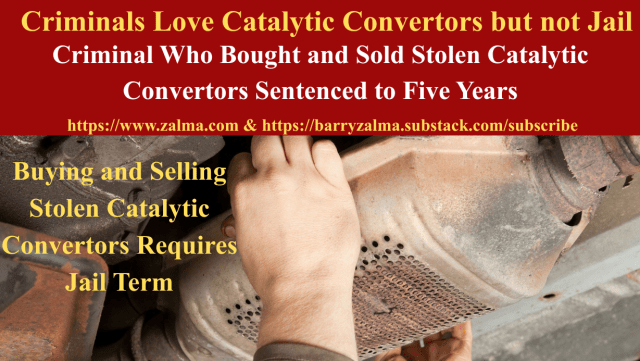 In Commonwealth Of Pennsylvania v. Michael Williams, No. 1409 EDA 2025, J-A03027-26, Superior Court of Pennsylvania (April 17, 2026) Michael Williams, operating TDI Towing, purchased approximately $2.7 million in stolen catalytic converters annually from individuals who removed them from vehicles in Bucks, Philadelphia, Montgomery, and Delaware counties. Williams then resold these converters for profit to an automotive store in New Jersey.
FACTUAL BACKGROUND:
Catalytic converters, which contain precious metals like rhodium, palladium, and platinum, were targeted due to the high market value of these metals during the relevant period. Williams was the boss of everything that occurred at TDI Towing-he ran the catalytic converter purchase and sales operation, gave instructions to employees to run the operation, and supplied the cash for the operation.
The purchasing of catalytic converters occurred 24 hours a day, 7 days a week and involved people from the street bringing in one or numerous catalytic converters at a time to sell to TDI Towing.
Williams knew that ninety-nine percent of the catalytic converters sold to TDI were stolen. Williams bought approximately one hundred seventy-five (175) catalytic converters per week and paid out an average of $300.00 per catalytic converter which was calculated to 2.7 million dollars for catalytic converters per year.
The court sentenced Williams on the single count of receiving stolen property to 30 to 60 months’ incarceration followed by two years of probation.
LEGAL ISSUES:
Williams pleaded guilty to receiving stolen property and related charges. The primary legal issue on appeal involved the discretionary aspects of his sentence.
COURT’S ANALYSIS AND DISCUSSION:
The Superior Court (acting as an appellate court) reviewed the trial court’s summary of facts and considered Williams’s challenge to the sentence imposed. The trial court’s sentencing memorandum reflects an assessment of the facts and the trial court’s application of sentencing discretion, with no indication that legal standards were misapplied.
Sentencing is a matter vested in the sound discretion of the sentencing judge, and a sentence will not be disturbed on appeal absent a manifest abuse of discretion. An abuse of discretion occurs where the sentencing court ignored or misapplied the law, exercised its judgment for reasons of partiality, prejudice, bias or ill will, or arrived at a manifestly unreasonable decision. The court adequately considered the mitigating factors, as well as the seriousness and duration of the crime in determining Williams’s sentence.
CONCLUSION:
The court affirmed the judgment of sentence, concluding that the trial court acted within its discretion regarding the punishment imposed for Williams’s offenses.
ZALMA OPINION
Convicted criminals unhappy with their sentence and appeal it to a higher court define the unmitigated gall expressed by the Yiddish word “Chutzpah”. Williams was a major criminal paying more than two million dollars to thieves 24 hours a day seven days a week and selling them over to others for a major profit. He was caught, found guilty and sentence to 30 to 60 months in prison and complained it was too much. He was wrong and should have been happy with the short sentence.

(c) 2026 Barry Zalma & ClaimSchool, Inc.
Please tell your friends and colleagues about this blog and the videos and let them subscribe to the blog and the videos.
Subscribe to my substack at https://gbarryzalma.substack.com/subscribe
Go to X @bzalma; Go to Barry Zalma videos at Rumble.com at https://rumble.com/account/content?type=all; Go to Barry Zalma on YouTube- https://www.youtube.com/channel/UCysiZklEtxZsSF9DfC0Expg; Go to the InsuranceClaims Library – https://lnkd.in/gwEYk.