
Arsonist Tried To Represent Himself, Failed, and Sought Habeas Relief
Post number 5357
See the full video at https://rumble.com/v7aer0y-he-who-acts-as-his-own-lawyer-has-an-idiot-for-a-client.html and at https://youtu.be/jH44B9nHyOU
Karacson’s Arson for Profit Attempt Required Skill & Experience to Succeed
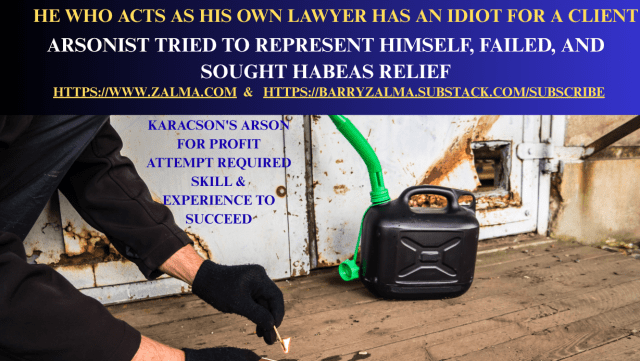 In Steve Ellis Karacson v. David Shaver, Warden, No. 25-1089, United States Court of Appeals, Sixth Circuit (May 20, 2026) Steve Karacson was convicted in Michigan state court of arson and insurance fraud after evidence showed he burned his own insured home. Investigators found multiple points of origin, gasoline odor, and evidence tying him to the scene, including cell-phone location data and a receipt showing he had purchased a gas can and gloves shortly before the fire.
FACTS
Karacson initially had appointed counsel, but his relationships with both appointed attorneys deteriorated. He filed grievances against them and ultimately expressed a desire to represent himself. The jury convicted him, and he was sentenced to seven years’ imprisonment.
LAW
Under the Antiterrorism and Effective Death Penalty Act (AEDPA), a federal court may grant habeas relief only if the state court’s decision was:
- Contrary to, or an unreasonable application of, clearly established Supreme Court precedent, or
- Based on an unreasonable determination of the facts.
The Sixth Circuit emphasized that AEDPA review is highly deferential: Karacson had to show that no fair-minded jurist could agree with the Michigan courts’ conclusion that he validly waived counsel.
DISCUSSION / ANALYSIS
The court first rejected Karacson’s attempt to avoid AEDPA deference. His claim that the Michigan Court of Appeals mischaracterized facts was, in the Sixth Circuit’s view, really a challenge to the state court’s legal judgment about waiver. That meant the deferential AEDPA standard still applied.
1. Knowing and Intelligent Waiver
The Sixth Circuit held that the record showed that:
- He twice stated that he wanted to represent himself.
- The trial court warned him that self-representation was risky, that he faced very serious charges, and that he would need to comply with complex procedural rules.
- He continued representing himself throughout trial despite repeated warnings and opportunities to reconsider.
His silence and later conduct did not undo the waiver, especially because he ultimately proceeded pro se without objection.
2. Adequacy of the Trial Court’s Inquiry
Karacson also argued that the judge’s warning was too brief and that the court failed to conduct the sort of “penetrating and comprehensive” warnings that the law required. The court compared the warnings here to those found sufficient that the trial judge adequately informed Karacson of the dangers and disadvantages of self-representation.
3. Voluntariness of the Waiver
Karacson argued that his waiver was not voluntary because he was forced to choose between unprepared counsel and self-representation. Instead, the attorney had negotiated bond issues, handled plea discussions, and appeared familiar with the case and law as standby counsel. Strategic disagreements — such as refusing to file certain motions or pursue Karacson’s preferred theory — did not establish lack of preparedness.
The District Court concluded that Karacson knowingly chose to proceed without counsel.
CONCLUSION
The district court denied relief, and the Sixth Circuit affirmed.
The Sixth Circuit held that the Michigan courts reasonably concluded that Karacson knowingly, intelligently, and voluntarily waived his right to counsel.
The Michigan Court of Appeals had denied Karacson’s right-to-counsel claim because he wasn’t entitled to substitute counsel on the morning of trial and the trial court reasonably determined that Karacson had waived his right to counsel. To obtain relief under AEDPA, Karacson needed to show that the Michigan court’s decision was:
- contrary to, or involved an unreasonable application of, clearly established Federal law, as determined by the Supreme Court of the United States or
- based on an unreasonable determination of the facts in light of the evidence before the state court.
Because AEDPA requires federal courts to defer unless the state decision is beyond the bounds of fair-minded disagreement, Karacson could not obtain habeas relief.
The Sixth Circuit concluded that the state court reasonably found that Karacson’s later actions didn’t undo his earlier waiver.
Here, the state trial court did much more than it needed. It explained the implications of Karacson’s charges. The Sixth Circuit concluded that Karacson’s claim of involuntary waiver fails even accepting them.
Karacson can’t show that his attorney was unprepared for trial. Instead, a fairminded jurist could decide that Karacson had a reasonable choice between adequate counsel and representing himself. So Karacson isn’t entitled to habeas relief on this ground either.
ZALMA OPINION
Someone criminal enough to set fire to his own house to defraud his insurer is also crazy enough to think he could do better defending himself than a licensed lawyer. He was wrong, convicted, and then desperately sought to turn aside his conviction because he was deprived of the right to competent counsel when he was convicted. Because he was properly warned his habeas failed.

(c) 2026 Barry Zalma & ClaimSchool, Inc.
Please tell your friends and colleagues about this blog and the videos and let them subscribe to the blog and the videos.
Subscribe to my substack at https://gbarryzalma.substack.com/subscribe
Go to X @bzalma; Go to Barry Zalma videos at Rumble.com at https://rumble.com/account/content?type=all; Go to Barry Zalma on YouTube- https://Cwww.youtube.com/channel/UCysiZklEtxZsSF9DfC0Expg; Go to the InsuranceClaims Library – https://lnkd.in/gwEYk.