

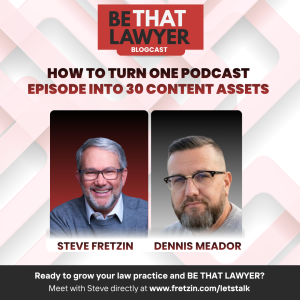
How Lawyers Can Build Authority With One Podcast Episode
By Steve Fretzin and Dennis Meador
How lawyers can use podcasting, content repurposing, and personal branding to build authority, stay visible, and generate opportunities without constantly creating something new.
Most lawyers who start a podcast probably have the wrong idea about what success looks like. They focus on downloads, subscriber counts, famous guests, and whether the show is generating new clients fast enough. When those results do not appear quickly, the podcast becomes another marketing initiative that gets abandoned.
But what if the podcast itself is not really the product? What if it is actually the starting point for an entire content marketing strategy?
In this episode of BE THAT LAWYER, I sat down with Dennis Meador, CEO and Founder of The Legal Podcast Network, to talk about a completely different approach to podcasting for lawyers. Dennis believes attorneys can get substantially more value from a podcast when they stop thinking like traditional podcast hosts and start thinking like subject matter experts and content creators.
Our conversation covered podcast positioning, legal content marketing, pricing, personal branding, content repurposing, consistency, and why one podcast episode should never remain just one podcast episode. Done correctly, a single conversation can become dozens of useful pieces of content that continue building your visibility long after the episode is released.
Why Most Lawyer Podcasts Take Too Long to Produce Results
Podcasting can be an incredibly effective legal marketing strategy, but Dennis is clear about one thing: it is not paid search. If you expect to turn on a podcast and immediately generate a predictable stream of leads, you are probably going to be disappointed.
Podcasting takes time because it is primarily a trust and authority building strategy. Prospective clients and referral sources need repeated exposure to you before they understand who you are, what you know, and why they should trust you. That process does not always happen after one episode or one LinkedIn post.
The mistake many lawyers make is evaluating a podcast exclusively through traditional podcast metrics. They want thousands of downloads when a much smaller, highly targeted audience might actually be more valuable. Dennis would rather see an attorney get 25 downloads from the right people with a specific problem than 10,000 downloads from people who will never hire or refer that attorney.
That changes the definition of success. The objective is not necessarily to become a famous podcaster. It is to become more visible and credible to the people who matter to your practice.
Flip the Podcast Format and Make the Lawyer the Expert
Dennis introduced one of the most interesting concepts in our conversation: the perpetual guest model.
Traditional podcasting usually positions the attorney as the host. The lawyer interviews guests, asks thoughtful questions, and helps those guests demonstrate their knowledge. The problem is that the guest is usually the person doing most of the talking, which means the guest often walks away looking like the expert.
Dennis believes attorneys should consider flipping that dynamic. Instead of always interviewing other people, the lawyer becomes the person answering the questions. A producer, cohost, or interviewer guides the conversation while the attorney explains legal issues, answers common client questions, shares insights, and demonstrates expertise.
This can be particularly powerful for lawyers because positioning matters. If your goal is to build authority around a specific legal problem, you need opportunities to demonstrate what you know. Being interviewed allows you to explain complex ideas conversationally rather than trying to squeeze your expertise into a perfectly written article or scripted video.
Dennis believes this shift can also shorten the time it takes for podcasting to create meaningful marketing value. Instead of spending years primarily promoting other people’s expertise, the attorney consistently becomes the subject matter expert featured in the content.
Podcasting for Lawyers Is Really a Content Strategy
This is where the conversation gets especially interesting. A lawyer may record a 30 or 40 minute podcast and think, “Great, I have this week’s episode.” Dennis sees something completely different. He sees the raw material for an entire legal content marketing strategy.
One podcast episode can potentially generate around 30 separate content assets. That can include short video clips, LinkedIn posts, quote graphics, blog articles, email content, social media posts, YouTube videos, FAQs, newsletters, and other pieces of thought leadership.
Now you are not spending 45 minutes creating one thing. You are spending 45 minutes creating the source material for weeks of marketing.
For busy lawyers, this matters tremendously. One of the most common things I hear from attorneys is that they do not have time to create content. In many cases, the real problem is not time. It is that they are trying to create every piece of content from scratch, which is both exhausting and inefficient.
A strong podcast creates a content engine. The conversation becomes the source, and the source can be broken down, rewritten, reformatted, and redistributed across the platforms where your clients and referral sources already spend their time.
How One Podcast Can Become Dozens of Content Assets
The key to content repurposing is understanding that different people consume information differently. Someone may never listen to a 40 minute podcast, but they might watch a 60 second LinkedIn clip. Another person may prefer reading an article. Someone else may notice a quote graphic, read an email, watch a YouTube video, or find an FAQ through Google or an AI search platform.
The underlying expertise can remain the same while the format changes. A single attorney podcast episode could potentially become:
- Several short video clips for LinkedIn, YouTube Shorts, Instagram, and other platforms
- Multiple LinkedIn posts built around individual insights from the conversation
- A long form SEO blogcast based on the primary topic
- Short FAQ content answering specific client questions
- Quote graphics featuring memorable insights
- A newsletter article or email
- A YouTube video with an SEO focused title and description
- Website content demonstrating expertise around a specific practice area
- Short written posts addressing individual problems discussed during the episode
- Future talking points for presentations, webinars, or client education
The important point is not whether every episode produces exactly 30 pieces. The bigger idea is that one conversation should create multiple marketing opportunities. This is how lawyers can create more content without constantly adding more content creation time to their calendars.
Content Repurposing Helps Lawyers Stay Top of Mind
There is another important benefit to this strategy: repetition. Lawyers sometimes worry about repeating themselves online because they assume that if they discussed a topic once, everyone has already seen it. In reality, most people probably missed it.
Your audience is busy. Algorithms are unpredictable. A prospective client may see your video but never read your article. A referral source may see your LinkedIn post three weeks after missing the podcast entirely. Repurposing gives your best ideas multiple opportunities to reach the right person.
That is especially important in relationship based business development for lawyers. Someone may not need your services today, but consistent exposure helps you remain familiar. When a legal need eventually arises, familiarity can help put you on the shortlist of attorneys they consider.
The content is not simply filling a social media calendar. It is helping you stay visible until the market needs you.
Why Podcast Downloads May Be the Wrong Metric
Dennis’s point about downloads deserves more attention because lawyers can become obsessed with metrics that have very little connection to actual business development.
Would you rather have 10,000 strangers listen to an episode or 25 CEOs in the exact industry you serve? For most lawyers, a smaller group of highly qualified listeners may have far greater business value.
A highly specialized attorney does not need millions of followers. They need visibility among the people who can hire them, refer them, or influence the decision to hire them.
That means measuring the success of a legal podcast should go beyond downloads. Lawyers should look at whether the podcast is helping create conversations, deepen relationships, increase visibility, support referrals, generate reusable content, strengthen search visibility, and position the attorney as an authority in a particular niche.
As Dennis puts it, “I’m not worried about them getting 10,000 downloads. I want them to get 25 downloads of people in their market with a very specific problem.”
Not Every Lawyer Should Start a Podcast
This does not mean every lawyer needs a microphone. Dennis is candid that podcasting is the wrong marketing strategy for someone expecting immediate gratification. If you want the instant lead flow that can sometimes come from paid advertising, podcasting will probably test your patience.
It also requires a willingness to put something of yourself into the content. The most effective podcasts are not sterile legal lectures. People connect with personalities, experiences, stories, perspectives, and authentic conversations. That does not mean lawyers need to overshare their personal lives. It means they need to be willing to sound like actual human beings.
A lawyer who hates communicating, refuses to be consistent, and expects immediate ROI may be better served by another marketing strategy. But an attorney who enjoys educating people, has a defined niche, and is willing to consistently demonstrate expertise may find podcasting to be a powerful long term personal branding strategy.
Personal Branding Is Becoming More Important for Lawyers
Podcasting is only one part of the larger conversation around personal branding for lawyers. Lawyers have historically relied heavily on their firm’s brand. If you worked at a respected law firm, the firm’s reputation created credibility. That still matters, but individual visibility is becoming increasingly important.
Clients research lawyers. Referral sources look them up. Prospects review LinkedIn profiles, articles, videos, podcasts, websites, and online reputations before ever reaching out. Your digital footprint is increasingly part of your first impression.
Podcasting gives attorneys an opportunity to create a deep library of expertise that exists independently of a single networking meeting or client conversation. Over time, that content helps answer a critical question in the mind of a prospective client: Does this lawyer understand my problem?
The more clearly your content answers that question, the easier it becomes for the right people to recognize your value.
Pricing Without Context Turns Lawyers Into Commodities
Our conversation also moved into pricing, and Dennis made an important point that applies well beyond podcasting. When someone asks what something costs before you understand what they actually need, quoting a number can immediately commoditize your value.
Without context, the conversation becomes a price comparison. The same thing happens to lawyers all the time. A prospect calls and asks, “How much do you charge?” If the attorney immediately provides a number without understanding the complexity, stakes, needs, or desired outcome, the prospect has very little information with which to compare lawyers other than price.
That can push you toward what Dennis describes as the market’s median low.
My approach has always been to diagnose before prescribing. Understand the situation before proposing the solution. Learn about the person’s objectives, problems, concerns, timing, and expectations before deciding whether you are even the right fit.
If someone refuses to let you understand the problem before demanding a price, that tells you something about the prospect too. Business development is not simply about getting someone to say yes. Sometimes the best outcome is recognizing that the relationship should not move forward.
Consistency Will Beat Bursts of Intensity
One of the strongest themes throughout my conversation with Dennis was cumulative effort. People love dramatic beginnings. They launch a podcast and record six episodes. They post on LinkedIn every day for two weeks. They attend four networking events in one month. They announce a new marketing initiative and attack it with tremendous enthusiasm.
Then life happens. Client work increases, the calendar gets busy, results do not appear fast enough, and the activity disappears.
Dennis’s philosophy is that bursts of intensity cannot compete with consistent, ethical effort that is regularly reviewed and improved. That applies to podcasting, content marketing, networking, personal branding, and almost every other form of business development.
You do not need to publish 100 pieces of content this month. You need a process you can maintain. One podcast every week or two that consistently produces multiple content assets can create an enormous library over several years. The same is true for networking. A few high quality relationship building meetings every week can produce more over time than attending 20 events one month and disappearing for the next six.
Compounding only works when you stay in the game.
Dennis Meador’s Biggest Lesson and the Long Road
One of the most valuable lessons Dennis shares is the importance of respecting the cumulative nature of success. Building companies, creating content, developing a podcast, establishing authority, and growing relationships rarely happen as quickly as people want.
The danger is burnout. When you attack every initiative at maximum intensity, you may get short term results, but you also make it harder to maintain the activity long enough for compounding to take effect.
Dennis’s experience scaling marketing companies and working with law firms has reinforced the value of consistent effort, review, improvement, and patience. The goal is not to find one giant marketing win that changes everything overnight. It is to create an approach you can continue executing and improving.
For lawyers, that may be the most important podcasting lesson of all. The attorneys who eventually dominate a niche through content are usually not the people who had the flashiest launch. They are the ones who kept publishing when everyone else stopped.
Key Takeaways
- Podcasting for lawyers should be viewed as a long term authority and content strategy rather than an immediate lead generation tool.
- A smaller audience of highly relevant prospective clients and referral sources can be more valuable than thousands of unrelated downloads.
- The perpetual guest podcasting model positions the lawyer as the expert answering questions instead of always promoting the expertise of guests.
- One podcast episode can become dozens of content assets, including videos, articles, LinkedIn posts, FAQs, newsletters, and quote graphics.
- Content repurposing allows lawyers to increase their visibility without constantly creating new ideas from scratch.
- Personal branding for lawyers is increasingly important because prospective clients and referral sources research attorneys before reaching out.
- Pricing legal services without understanding the prospect’s needs can turn a value conversation into a commodity comparison.
- Not every lawyer should start a podcast, particularly attorneys who expect immediate results or are unwilling to consistently create and share content.
- Sustainable legal marketing depends on consistent effort rather than occasional bursts of activity.
- Podcasting works best when integrated into a larger law firm content marketing and business development strategy.
A Quote to Remember
“I’m not worried about them getting 10,000 downloads. I want them to get 25 downloads of people in their market with a very specific problem.” — Dennis Meador
Frequently Asked Questions About Podcasting for Lawyers
Is podcasting a good marketing strategy for lawyers?
Podcasting can be an effective marketing strategy for lawyers who want to build authority, strengthen their personal brand, educate prospective clients, and create long term visibility. It is generally better suited to attorneys willing to consistently invest in thought leadership than those looking for immediate leads.
How can lawyers use podcasts to get clients?
Lawyers can use podcasts to demonstrate expertise around the specific problems their ideal clients face. Rather than focusing only on podcast downloads, attorneys can distribute podcast clips, articles, social posts, videos, and FAQs that reach prospective clients and referral sources across multiple channels. The objective is to build familiarity and trust before someone needs legal services.
How can one podcast episode become multiple pieces of content?
A single podcast conversation can be repurposed into short form videos, LinkedIn posts, SEO articles, newsletters, YouTube content, quote graphics, FAQs, website content, and other educational materials. Instead of treating the podcast as the finished product, lawyers can treat the recording as source material for a broader content marketing strategy.
How many content assets can come from one podcast episode?
Depending on the length and quality of the conversation, one podcast episode can potentially generate 20, 30, or more separate content assets. The exact number matters less than having a repeatable system that identifies strong ideas and converts them into formats appropriate for different marketing channels.
How many podcast downloads does a lawyer need for the show to be successful?
There is no universal download number that determines success for a legal podcast. A niche attorney may generate greater business value from 25 highly relevant listeners than from thousands of listeners outside the attorney’s target market. Audience quality, engagement, relationships, visibility, and business opportunities can be more meaningful metrics than raw downloads.
What should lawyers talk about on a podcast?
Lawyers should focus on the questions, problems, misconceptions, and decisions their ideal clients regularly encounter. The strongest podcast topics generally align the attorney’s expertise with issues that prospective clients are actively researching or discussing. This also creates useful source material for search friendly articles, videos, FAQs, and social content.
Should lawyers host a podcast or be interviewed on one?
Both approaches can work, but Dennis’s perpetual guest model offers an interesting alternative for attorneys focused primarily on thought leadership. When the lawyer answers questions rather than always asking them, the attorney gets more opportunities to demonstrate expertise and create content featuring their own insights.
Is podcasting good for a lawyer’s personal brand?
Yes. A podcast can create a searchable library of a lawyer’s knowledge, personality, perspective, and experience. When combined with LinkedIn, video, written articles, and other content, podcasting can become an important component of a lawyer’s personal branding and legal marketing strategy.
How long does it take for a lawyer’s podcast to produce results?
Podcasting is generally a long term marketing strategy. Dennis believes changing the positioning and using the podcast more strategically as a content engine can accelerate the payoff, but lawyers should still approach podcasting with realistic expectations. Consistency and cumulative effort matter more than expecting immediate results from the first few episodes.
Continue Learning with BE THAT LAWYER
Check out my new show, BE THAT LAWYER Coaches Corner, where I share the strategies I use with my clients to win more business, develop better habits, strengthen relationships, and love their careers again.
Join the BE THAT LAWYER Community
Join the BE THAT LAWYER Community and connect with ambitious lawyers who are serious about growing their books of business, strengthening their brands, improving their business development skills, and becoming confident, consistent rainmakers.
https://BETHATLAWYER.com/community/
Go From Good to GOAT with PIMCON
Ready to go from good to GOAT in your legal marketing game? Don’t miss PIMCON, where some of the brightest minds in professional services gather to share what is actually working in marketing and business development.
Thank You to Our Sponsors!
Thank you to our sponsors for their continued support of BE THAT LAWYER and the legal community.
LEX Reception: https://www.lexreception.com/partners/bethatlawyer
Rankings.io: https://rankings.io/
Lawyer.com: https://www.lawyer.com/
Ready to Grow Your Law Practice?
Ready to grow your law practice without selling, pitching, or chasing? Book your free 30 minute strategy session and let’s identify where your business development can improve and how to build a more consistent approach to growing your book.
About Dennis Meador
Dennis Meador is the CEO and Founder of The Legal Podcast Network, providing turnkey podcasting and content solutions for legal professionals across the United States. An entrepreneur since age 14, he brings more than 20 years of experience in law firm marketing, having scaled three marketing companies from under $1 million to more than $3 million to $5 million in revenue within one to three years each.
Combining a background in business, digital marketing, and podcast production, Dennis helps attorneys establish market authority, differentiate their practices, and engage prospective clients through authentic, conversation driven audio and video content.
Connect with Dennis Meador
Website: https://www.thelegalpodcastnetwork.com/
LinkedIn: https://www.linkedin.com/company/the-legal-podcast-network/
Connect with Steve Fretzin
LinkedIn: https://www.linkedin.com/in/stevefretzin/
Twitter: https://twitter.com/stevefretzin
Instagram: https://www.instagram.com/fretzinsteve/
Facebook: https://www.facebook.com/fretzinsteve
Website: https://BETHATLAWYER.com/
Email: Steve@Fretzin.com
Books: https://www.fretzin.com/about/books/
YouTube: https://www.youtube.com/user/SalesResultsInc
Call Steve directly: 847-602-6911
Audio production by Turnkey Podcast Productions. You’re the expert. Your podcast will prove it.
The post How to Turn One Podcast Episode Into 30 Content Assets appeared first on FRETZIN, INC..