

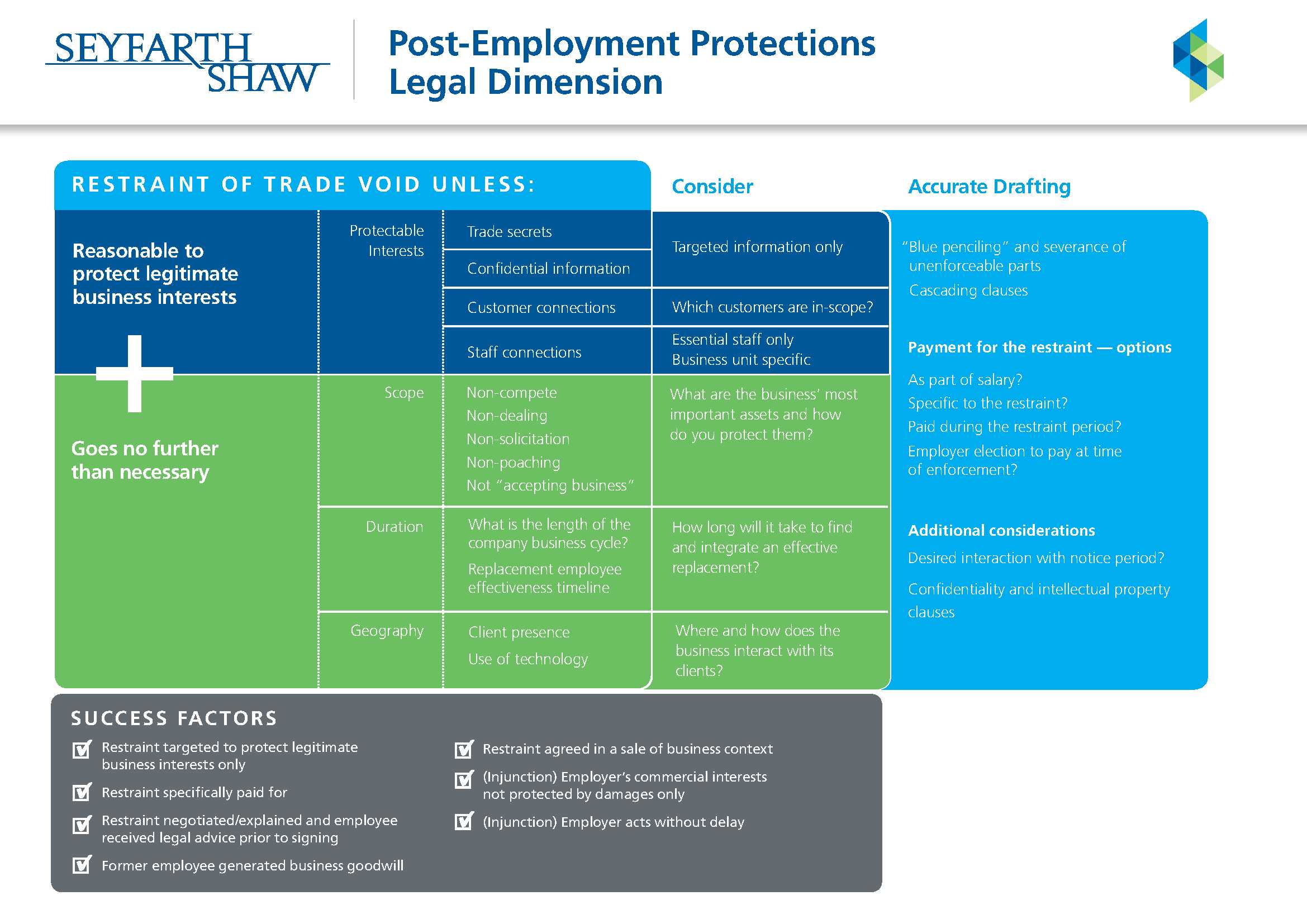
An enforceable restraint of trade can be a key business asset. Or some might think about it as an insurance policy. The capacity to preserve customer connections, protect confidential information and discourage key executives from setting up their own business or moving to a competitor can be critical to information rich businesses operating in a competitive market. As we pointed out in our second blog piece on post-employment protections, ensuring the currency of your restraint provisions is an important exercise in risk management.
Experience in this area demonstrates one key distinction which separates cases where restraints are successfully upheld and those where compromise outcomes are achieved. In successful cases, typically, the restraint provision has been drafted quite neatly around the key protectable interests. When seeking to enforce a restraint, an employer will be required to show there is a protectable interest capable of supporting the restraint. This is the first limb of the test for enforceability. The scope, duration and geographical operation of the restraint are logically tied to the protectable interest (see our map below). An employer will need to make out each of these elements to meet the second limb of the test.
This success can be attributed to the practice of regularly revisiting the questions of which key executives or employees should be subject to restraints, and how those restraints should operate. The yearly promotion, pay rise or management re-shuffle cycles are perfect opportunities to update restraint provisions. Often, this is when operational changes (such as the make-up of roles) become effective, so restraints can be tweaked to align with these changes. A promotion or pay rise can be tied to a new contract or restraint provision. Instead of adopting a one-size-fits-all approach when an employee first joins the business, employers can increase the likelihood that a restraint will be enforceable by showing it was the subject of specific negotiation during the employment.

If the restraint then needs to be relied upon down the track, the employer has the benefit of a provision which protects a current business asset (e.g. key connections with important customers or suppliers who the employee is in contact with) and is likely to be enforceable in Court. If the opportunity to update a restraint has been missed, it’s then necessary to try to force fit the facts into a restraint that might have been drafted years earlier in a very different business context – for example, when the employee was performing a different role. This can increase the degree of difficulty when enforcing a restraint substantially. Although Courts will give employers some latitude, because the reasonableness of a restraint is judged at the time it was entered into, that latitude is limited. Regular housekeeping means that it won’t be necessary to call on this latitude because the restraint is fit for its purpose, and enforcement proceedings can be approached with confidence.