I’ve told you that I spend a lot of time writing because I can’t do all the outdoor activities I used to enjoy.
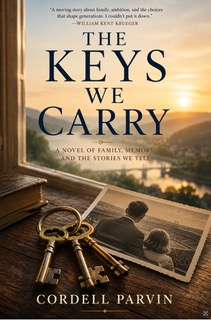
My latest novel, which is now published, is The Keys We Carry. You can find paperback, hard cover and E-addtions on Amazon.
When I started writing The Keys We Carry, Claire’s mother was barely in the novel.
Margaret had already died, and I thought I was writing a father-daughter story about Claire Harlan, a successful Houston construction lawyer, trying to understand her father as dementia takes away his ability to explain himself.
But something was missing.
When I added more about Margaret in a later draft, I described her as the kind of woman who showed up with a casserole when someone at church was sick. She was kind, dependable, and devoted to her family.
She was also boring.
I realized I had made her into the supporting character in her husband’s life. The more I thought about it, the more I wondered whether that was exactly the mistake Claire might have made when thinking about her mother.
So I started over with Margaret.
Margaret marries Bob while she is still in college. She wants to become a doctor and has the grades and ability to do it. But she comes of age at a time when women seeking careers in medicine, law, engineering, and other professions faced obstacles that would be difficult for younger generations to imagine today. Margaret encounters a medical-school admissions system that sees a married woman who may have children as a poor investment.
She becomes a nurse instead.
She builds a good life. She loves her husband and daughter. But the life she builds is not necessarily the life she once imagined.
And Claire knows almost none of this.
That became important to me because I have spent much of my life around lawyers.
When I entered law school, there were 125 students in my first-year class. Only two were women. Today, women make up more than half of the students in American law schools.
During my 37 years practicing law and another 15 years coaching lawyers, I watched enormous changes take place in our profession. I also met many talented men and women trying to answer a question that has never completely gone away:
How much of your life should you give to your career?
That question eventually became one of the threads running through The Keys We Carry.
Bob leaves Knoxville for greater professional opportunities. First Nashville. Then Houston. He becomes a highly successful lawyer, but his heart is still in Knoxville.
His daughter Claire follows a remarkably similar path. She becomes one of Houston’s most successful construction lawyers and tells herself, as many of us have, that the sacrifices are simply part of what success requires.
Then there is the next generation.
Claire’s daughter is offered a promotion, more money, and a move to Dallas. She turns it down.
She likes her life in Houston.
When I first wrote that scene, I realized how differently the three generations viewed the same choice.
Bob would have seen the opportunity and asked when he needed to leave.
Claire would have accepted before the offer was finished.
Her daughter asks a different question: What am I giving up to get it?
Margaret helped me understand that this was the story I had been trying to write all along.
Not whether ambition is good or bad. I would be a hypocrite if I suggested ambition was bad. My own ambition took Nancy and me from Roanoke to Richmond and eventually to Dallas, and it gave me a career for which I remain enormously grateful.
The harder question is whether we recognize what our choices cost while we still have time to choose differently.
And there is another question that became even more important as I wrote Margaret:
How well do we really know our parents?
We know them as Mom and Dad. We know the stories they chose to tell us. But we may know surprisingly little about the young people they once were, what they wanted before we came along, what they gave up, and what they might have done differently. As an example, only recently did I learn my father’s B-17 was shot up in his last mission and barely made it back to England. He never told me that story.
Claire begins The Keys We Carry believing she is trying to understand her father.Along the way, she discovers she didn’t fully understand her mother either. And eventually, she has to decide how well she understands herself.
The Keys We Carry is now available on Amazon. If you are a lawyer who has ever wondered whether the next promotion, the next client, the next opportunity, or the next move was worth what it required you to leave behind, I wrote part of this story with you in mind.
I hope this is the kind of story you will want to read and share with other lawyers in your firm. .