
Material Fact Not Proved Defeats Summary Judgment
Post number 5314
See the full video at https://rumble.com/v77vama-when-genuine-disputes-of-material-fact-exist-summary-judgement-fails.html and at https://youtu.be/Y8a0R8scJJQ
 In Peleus Insurance Company, on its own behalf and on behalf of Bais Yaakov Dkal Adas Yereim and BT General Builders, Inc. v. United Specialty Insurance Company, No. 24 Civ. 1398 (KPF), United States District Court, S.D. New York (March 23, 2026) Peleus Insurance Company (“Peleus”), on behalf of itself and insureds Bais Yaakov Dkal Adas Yereim (“Bais”) and BT General Builders, Inc. (“BT”), initiated an action against United Specialty Insurance Company (“USIC”) in the United States District Court for the Southern District of New York. Peleus sought declaratory judgment regarding USIC’s obligations to defend and indemnify its insureds in connection with an underlying personal injury lawsuit pending in the Supreme Court of the State of New York, Kings County. Both parties cross-moved for summary judgment concerning USIC’s duty to defend.
FACTUAL BACKGROUND
The underlying action arose from an accident at a construction site located at 184-198 Nostrand Avenue, Brooklyn, New York, where Jonathan Caceres, employed by Charles Contractors Corp., sustained injuries while carrying a stone slab up a staircase. Caceres sued BT and Bais in state court, alleging negligence and violations of New York Labor Law Sections 200, 240, and 241(6). At the time of the accident, Charles Contractors was engaged in stonework at the site. Caceres’s injuries occurred when he slipped on water, lost control of the slab, and the slab fell on his left foot.
LEGAL STANDARDS
The motions for summary judgment required the court to determine whether USIC owed a duty to defend and indemnify BT and Bais as “additional insureds” under USIC-issued policies. The duty to defend is typically broader than the duty to indemnify and hinges on the terms of the insurance policy and the allegations in the underlying complaint.
COURT’S ANALYSIS AND DISCUSSION
The court’s analysis centered on the timing and validity of the agreement purportedly extending additional insured coverage to BT and Bais under USIC’s policies. Both parties argued for summary judgment on USIC’s duty to defend, but the court found a material dispute regarding whether the relevant agreement was executed before the accident occurred. This factual uncertainty precluded a definitive ruling on coverage and defense obligations. The court concluded that, due to unresolved factual questions concerning the execution date of the agreement, neither party was entitled to summary judgment.
CONCLUSION
The court denied both Peleus’s and USIC’s motions for summary judgment. The outcome preserves the need for further proceedings to resolve the disputed facts, particularly regarding the timing of the agreement that could trigger USIC’s duty to defend and indemnify.
Insurance policies are, in essence, creatures of contract, and, accordingly, subject to principles of contract interpretation. The initial interpretation of a contract is a matter of law for the court to decide.
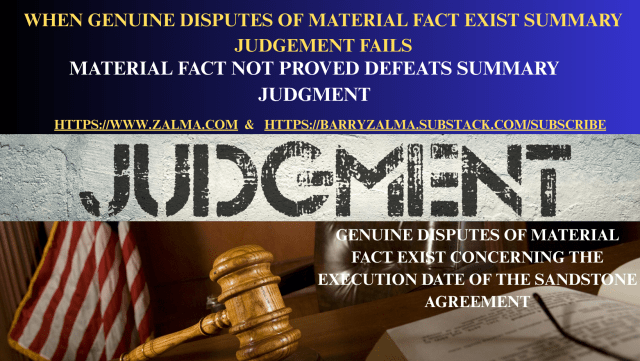
Genuine Disputes of Material Fact Exist Concerning the Execution Date of the Sandstone Agreement
The parties do not seriously dispute that, if the Court finds that BT and Bais qualify as additional insureds under the USIC Policy, USIC would have a duty to defend them in the Underlying Action. Instead, the parties dispute the antecedent question of whether BT and Bais qualify as additional insureds under the USIC Policy.
In point of fact, these recitals do not mean that the Sandstone Agreement was executed on April 20, 2022, prior to Mr. Caceres’s alleged Accident. The evidence concerning the execution date of the Sandstone Agreement raises genuine disputes of material fact. In short, Peleus has not proved, nor has USIC disproved, that BT and Bais qualify as additional insureds under the USIC Policy for two separate reasons, one temporal and one intent-based. In the absence of a more developed factual record, resolution of that issue will have to wait until trial.
The decision underscores the importance of clear documentation and timing in additional insured coverage disputes and serves as a reminder that summary judgment is inappropriate when material facts remain contested.
ZALMA OPINION
Additional insured endorsements are important to every insured doing business where the contract requires them to make others insureds on the named insured’s policy. They are prevalent in construction contracts where the general contractor and owner try to shift the risk of loss to the subcontractors policies. In this case, the contract promising to make another an additional insured was not signed until after the accident and summary judgment was not proper.
(c) 2026 Barry Zalma & ClaimSchool, Inc.
Please tell your friends and colleagues about this blog and the videos and let them subscribe to the blog and the videos.
Subscribe to my substack at https://gbarryzalma.substack.com/subscribe
Go to X @bzalma; Go to Barry Zalma videos at Rumble.com at https://rumble.com/account/content?type=all; Go to Barry Zalma on YouTube- https://www.youtube.com/channel/UCysiZklEtxZsSF9DfC0Expg; Go to the InsuranceClaims Library – https://lnkd.in/gwEYk.