

Link to Introduction Introduction

Robots competing for medals may once have belonged firmly in the realms of science fiction. Not anymore. The 2026 World Humanoid Robot Games (the “Games”), which took place in Beijing from 22-26 August, assembled some of the world’s most advanced humanoid machines in a competition designed to test speed, strength, dexterity, dexterity and intelligence.
By bringing together cutting-edge robots to run, jump, fight, play football and perform increasingly complex tasks, the recent Games have moved beyond being a robotics demonstration into something resembling an actual international multi-sport competition. Sport has always evolved alongside technology, but the relationship has moved into unfamiliar territory.
Innovation on this scale rarely arrives without legal complexity. Rules built around human competitors do not translate neatly to “athletes” comprising algorithms, sensors and steel. As outlined below, this raises a number of novel questions about responsibility, safety, eligibility, competitive fairness, cybersecurity, governance and the classification of “sport”. The Games therefore offer more than a glimpse of the future of robotics: they provide an early test of whether the law and regulatory framework can keep pace.
Link to What are humanoid robots? What are humanoid robots?
Humanoid robots are robots designed to resemble and/or function like the human body. They typically have a human-like physical structure (i.e. a torso, head, two arms and two legs) and are engineered to perform movements or tasks associated with people, such as walking, running, manipulating objects and interacting with their surroundings.

What distinguishes a humanoid robot from a conventional industrial robot is not simply its physical appearance; its functional characteristics are as important. A humanoid may combine the following capabilities:
- Actuators and joints – that replicate human movement, allowing it to walk, bend, turn, kick or grasp.
- Sensors (including cameras, microphones, force sensors and inertial sensors) – that allow it to perceive its environment and maintain balance.
- Computing and AI systems – that interpret those inputs and determine how the robot should respond.
- Control software – that converts decisions into physical movements.
Link to What is the World Humanoid Robot Games? What is the World Humanoid Robot Games?
Launched in Beijing in 2025, the Games are billed by the organisers as “the world’s first international, comprehensive science and technology sports event with humanoid robots as the primary competitors”. [1] The Games combine the familiar format of a major sporting event with a showcase of cutting-edge robotics: robots compete in conventional sporting disciplines such as athletics, football and martial arts, and practical scenarios designed to replicate tasks in factories, restaurants, offices and emergency environments. As outlined in Table 1 (below), the second edition of the Games has seen a rapid expansion in both the scale and sophistication of the competition programme in the space of just 12 months.
Link to Table 1: Comparison of 2025 and 2026 Games Table 1: Comparison of 2025 and 2026 Games
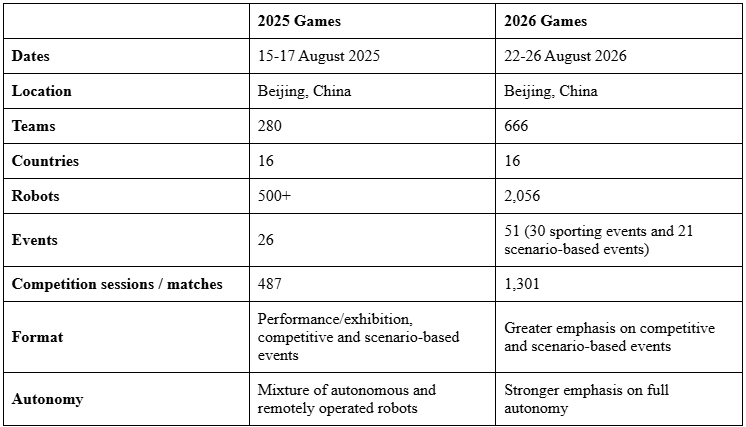
The sporting programme is deliberately modelled on recognisable human sports and covered nine broad disciplines – see Table 2 below. It does not simply replicate a conventional multi-sport event with robots substituted for humans. The sporting disciplines are effectively technological stress tests: athletics tests locomotion and balance; football tests perception, decision-making and collaboration; martial arts test stability and reaction; weightlifting and tug of war test power, grip and dynamic reaction; gymnastics and dance test coordination and complex sequences of movement; and table tennis and pitch-pot (a traditional Chinese arrow-throwing game[2]) test manipulation and dexterity.
Link to Table 2: Sporting Programme for 2026 Games[3] Table 2: Sporting Programme for 2026 Games[3]

See fn[4] for an explanation of Pitch-pot.
Link to The significance of autonomous performance The significance of autonomous performance
For the 2026 edition of the Games, the rules increasingly required robots to perform fully autonomously, rather than being partly or wholly controlled by a human operator. The significance of this is that autonomy becomes part of the competitive achievement, rather than merely a technical characteristic of the robot.
Autonomous performance therefore represents the critical dividing line between a sophisticated machine controlled by human intelligence and one capable of exercising its own decision-making capabilities. It is this distinction that transforms the Games from a spectacle of mechanical engineering into a meaningful test of AI.
Link to Competition Highlights Competition Highlights

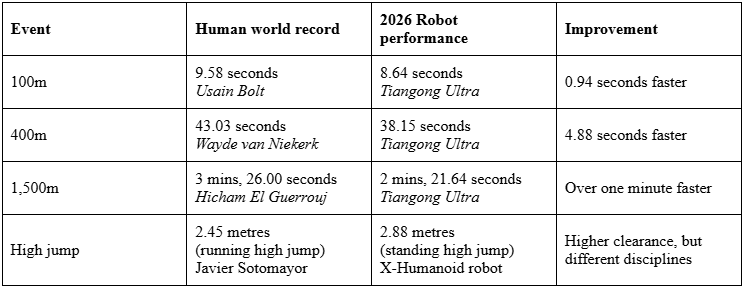
One of the distinctive features of the 2026 Games was humanoid robots beginning to surpass human physical performance in certain measurable disciplines.
Link to Table 3: Notable “records” broken at the 2026 Games Table 3: Notable “records” broken at the 2026 Games
Source: RoboPodium
Some may sensibly question the value of such comparisons (it’s not as if robots suffer from lactic acid build-up!). Differences in physiology, engineering, competition rules and permitted technologies mean that human and robot records are not directly equivalent. That said, and regardless of how gimmicky certain press headlines might have been at the time, the “records” do provide a tangible yardstick. Moreover, they illustrate the pace of advancement in humanoid robotics, particularly in locomotion, balance, coordination and mechanical efficiency.
Link to Legal challenges in an unconventional landscape Legal challenges in an unconventional landscape
Beneath the familiar trappings of a conventional sporting competition lies a distinctly unconventional legal landscape. Unlike traditional sport, where the rules are designed to regulate human behaviour and performance, the organisers must grapple with the complexities of an entirely new type of competitor. Below are just some of the key legal challenges that need careful consideration.
Link to 1. Legal responsibility for an autonomous robot 1. Legal responsibility for an autonomous robot
If an autonomous robot breaks the rules, who committed the infringement? Potential responsibility could rest with the team, manufacturer, programmer, AI-system developer or operator. A sporting regulatory regime normally assumes that conduct can ultimately be attributed to a human or legal person. Autonomous robotics complicates that assumption. Competition rules therefore need something analogous to strict liability: the team is responsible for the conduct of its robot irrespective of whether the particular action was specifically instructed or foreseeable. This becomes particularly interesting if machine-learning systems adapt their behaviour during competition.
Link to 2. Safety, negligence and product liability 2. Safety, negligence and product liability
The Games provide a very visible demonstration of the physical risks associated with increasingly powerful autonomous machines. For example, during some athletic events, robots were observed crashing into padded barriers due to difficulties turning or decelerating. If a robot injures a spectator, official or competitor, questions could arise over whether the injury resulted from defective hardware, negligent programming, inadequate supervision, insufficient venue precautions or an unforeseeable autonomous decision. The issue becomes considerably more significant once humanoid robots move from controlled arenas into workplaces and public environments, which is precisely what some of the scenario competitions are designed to test.
Link to 3. Technical eligibility 3. Technical eligibility
This is effectively the Games’ equivalent of athlete eligibility. The competition rules already prescribe morphological requirements. Participating robots must have a torso, upper limbs and bipedal legs, together with specified proportions relating to their centre of gravity and height. As robotic design becomes increasingly sophisticated, those classifications are likely to become contentious. A manufacturer may seek to develop a robot that technically satisfies the definition of a “humanoid robot” while exploiting characteristics that give it a substantial competitive advantage. That may create a familiar regulatory tension between rules-based compliance and the underlying purpose of an eligibility rule.
Link to 4. Sporting integrity / technological cheating 4. Sporting integrity / technological cheating
Integrity regulation will become increasingly important if the Games develop into serious international competition. Potential manipulation includes interference with another team’s communications, so-called “sensor spoofing”, deliberate wireless interference, malicious software and hacking. Interestingly, the rules already recognise part of this problem: teams must provide their own network connectivity and must ensure that their use of it does not interfere with the Games. The rules also prohibit certain forms of technological performance enhancement (e.g. elastic propulsion and launch devices are banned in jumping events). This may feel closer to the regulation of motorsport than, say, anti-doping in human sport, but a similar overarching question arises: where does legitimate optimisation end and illicit performance enhancement begin?
Link to 5. Cybersecurity 5. Cybersecurity
Cybersecurity is not merely an IT issue; it potentially becomes a competition integrity issue. A compromised robot could be instructed to lose, interfere with another robot or even behave dangerously. That creates difficult regulatory questions around minimum cybersecurity standards and whether teams should be liable where inadequate cybersecurity allows third-party interference.
Link to 6. Intellectual Property 6. Intellectual Property
The Games are effectively placing commercially valuable R&D into public competition. That creates substantial IP issues involving patents, copyright, confidential information, trade secrets, licensing and ownership of competition-generated data. Teams will understandably want to protect algorithms, mechanical designs and training methods while organisers may require access to those systems for regulatory inspection. This becomes particularly important because the Games are increasingly being treated as a commercial testing ground rather than simply entertainment.
Link to 7. Data ownership 7. Data ownership
Each competition potentially generates enormous quantities of valuable data through cameras, microphones, sensors and monitoring systems. But who owns this data – the manufacturer, the team, the organisers, the AI developer? Competition entry agreements will increasingly need careful provisions governing data ownership, access, licensing and commercial exploitation. Indeed, for manufacturers, data concerning competitive “failures” may actually be more commercially valuable than the sporting result.
Link to 8. Export controls and national security 8. Export controls and national security
This could ultimately become one of the biggest barriers to the Games being truly global. Teams travelling internationally may encounter export controls, technology-transfer restrictions, sanctions, customs restrictions and national-security screening.
A country may be perfectly willing for its company to enter a running robot while being considerably less willing for that company to expose advanced autonomous-navigation or machine-vision technology to overseas competitors. In July 2026, the U.S. Federal Communications Commission (“FCC”) added foreign-produced advanced robotic devices, including humanoid robots, to its list of equipment deemed to pose an unacceptable risk to national security.[5] The move was criticised by China, which dominates the global market for humanoid robots with an estimated market share of roughly 85%. Meanwhile, the EU Artificial Intelligence Act (Regulation (EU) 2024/1689) introduces a risk-based regulatory framework under which AI systems incorporated into humanoid robots may be classified as high-risk, depending on their intended purpose, safety functions and applicable product legislation.[6]
Link to 9. Governance and dispute resolution 9. Governance and dispute resolution
As the Games grow in scale, sophistication and commercial significance, robust governance and effective dispute resolution mechanisms will become increasingly important. Much like traditional sport, the Games will require clear rules governing eligibility, competitive integrity, technical compliance and disciplinary sanctions. However, the complexity of AI and robotics introduces challenges that conventional sporting frameworks may be ill-equipped to address. Disputes over prohibited human intervention, software manipulation or technical infringements may require specialist expertise, access to commercially sensitive information and decisions delivered within tight timescales. There is also the question of who should regulate the regulators, particularly where organisers, manufacturers and commercial stakeholders have competing interests. While established sporting models, including motorsport’s technical regulations and specialist sports arbitration, offer useful precedents, the Games may ultimately require a bespoke governance framework.
Link to 10. Is it really “sport”? 10. Is it really “sport”?
There is also a more fundamental question lurking beneath the spectacle: are the Games really a sport at all? On one view, they possess many of the hallmarks of conventional sporting competition: established disciplines, codified rules, competitive rankings and the pursuit of record-breaking performances. Yet, unlike traditional sport, the physical feats are performed by machines rather than human athletes, with success determined as much by engineering ingenuity and AI as by anything resembling athletic prowess. The comparison with motorsport and esports is instructive, although neither provides a perfect analogy. While the distinction may appear largely philosophical, legal classification could affect governance, gambling regulation, broadcasting rights, competition law, insurance and even the applicability of sporting arbitration structures.
Link to The future: pushing the boundaries of competitive performance The future: pushing the boundaries of competitive performance
The 2026 Games offer an intriguing glimpse into the future of competitive sport. The ability to sprint faster, jump higher or demonstrate exceptional mechanical precision is impressive, but the real technological breakthrough will come when robots can consistently perceive, reason, adapt and act independently. The direction of travel is already apparent. The 2026 Games expanded beyond conventional sporting contests into real-world scenarios, including industrial operations, household tasks and emergency response. By requiring robots to perform more complex tasks in realistic environments, the organisers signalled a shift towards assessing practical utility alongside sporting prowess.
The ambition to redefine the boundaries of competitive performance is not unique to humanoid robotics. Interestingly, parallels can be drawn with the Enhanced Games, a controversial international multi-sport competition in which athletes are permitted to use certain performance-enhancing substances. Although the two competitions may appear to inhabit entirely different sporting worlds, they share a common ambition: to challenge conventional limits on competitive performance. One seeks to enhance the capabilities of the human body; the other seeks to replicate (and ultimately surpass) human capabilities through AI and engineering. Both raise a fundamental question for sport and its regulators: where should the boundaries of competitive performance be drawn?
From a legal and regulatory perspective, technological progress brings unique challenges that conventional sporting rules were never designed to address. Ultimately, the enduring legacy of the 2026 Games may lie less in the records broken than in the questions they raise about the future relationship between humans and intelligent machines. The challenge for regulators will be to ensure that the rules governing humanoid robotics evolve as quickly as the technology itself, without stifling the innovation that makes these developments possible.
[1] According to the Games’ official website (English translation), the Games are jointly hosted by the Beijing Municipal People’s Government, China Media Group, World Robot Cooperation Organisation, and the Asia-Pacific Robot World Cup International Council.
[2] Also known as tóuhú, players stand a set distance away and toss a specified number of arrows, trying to land them inside the pot to score points based on accuracy.
[3] Source: John Koetsier, ‘The Humanoid Robot Games Events are a Market Map’ (Forbes, 19 August 2026).
[4] A traditional Chinese game in which competitors throw arrows into a pot. Its inclusion is designed to test fine motor control and dexterous manipulation.
[5] The decision effectively prevents new models of covered devices from obtaining the FCC authorisation required to enter the U.S. market, although it does not generally prohibit the continued sale or use of previously authorised models.
[6] Where classified as high-risk, such systems are subject to additional regulatory requirements, including risk management, technical documentation, human oversight and conformity assessment.