
Arbitration Award Prevents Bad Faith Claims
Post number 5298
See the video at https://rumble.com/v76oe5w-anti-assignment-clause-of-policy-defeats-attempt-to-assign.html and at https://youtu.be/96t5iEREGg0
Why Consent to $9 Million Judgment and Assignment to Sue Insurer was Worthlessa
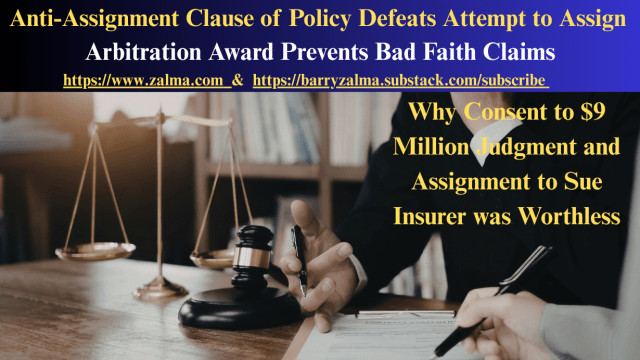 In Carmen Ciotola, as assignee Of Quarterback Transportation, Inc. v. RSA Insurance Group, PLC, et al., Civil Action No. 3:21-1020, United States District Court, M.D. Pennsylvania (March 2, 2026) resolved the dispute brought by Ciotola. Carmen Ciotola, as assignee of Quarterback Transportation, Inc., brought an insurance action against RSA Insurance Group, PLC (now RSA Insurance Group Limited) and its subsidiaries, alleging breach of contract and bad faith.
FACTUAL BACKGROUND
The dispute arose from a motor vehicle accident on November 12, 2018, in Luzerne County, Pennsylvania, involving Ciotola and Quarterback. At the time, Quarterback held a $7,000,000 primary insurance policy with Chubb Insurance Company and a $1,000,000 excess liability policy with RSA under the Comprehensive Logistics Policy.
After Ciotola sued Quarterback for personal injury, RSA allegedly failed to assign counsel or defend Quarterback as required by the policy. Negotiations failed, leading Quarterback to settle with Ciotola by consenting to a $9,000,000 judgment and assigning its claims against RSA to Ciotola. In exchange, Ciotola agreed not to enforce the judgment against Quarterback.
RSA filed a joint motion to compel Ciotola to proceed with arbitration to resolve his claims in accordance with the arbitration clause in the RSA policy. The USDC granted RSA’s motion, issuing an order to stay Ciotola’s claims pending arbitration and administratively closing the case.
On February 21, 2025, Arbitrator Scott W. Densem rendered his findings. Notably, it was Quarterback, rather than Ciotola, who initiated this arbitration against RSA. In his decision, Mr. Densem found that the Assignment Agreement between Quarterback and Ciotola was “a nullity” and that it “has no legally binding effect on RSA”. He further found that Quarterback was entitled to indemnity under the RSA policy for the $500,000 amount that it paid to Ciotola as part of their Settlement Agreement.
Thereafter, Ciotola filed the instant request to re-open this case in order to proceed with his claims for bad faith and breach of contract against RSA. Given the Arbitrator’s findings that the Assignment Agreement was legally invalid, Ciotola had no standing to proceed with his claims against RSA.
LEGAL ISSUES
The central legal issues involved claims for breach of contract and bad faith under the insurance policy. The claims focus on RSA’s alleged failure to defend Quarterback and its refusal to settle the underlying personal injury claim within policy limits. The assignment of rights from Quarterback to Ciotola was a key aspect, as it forms the basis for Ciotola’s standing to pursue these claims against RSA.
DISCUSSION
The main points of contention were whether RSA breached its contractual duties and acted in bad faith regarding the defense and settlement obligations. The facts indicate that RSA did not respond to settlement demands and failed to provide a defense, which led to the assignment agreement and the consent judgment.
ANALYSIS
After reviewing the procedural history and the nature of the claims, the court found that Plaintiff’s request to reopen the case was not warranted. The conclusion that the arbitration and settlement process had resolved the relevant issues, and there was no sufficient basis to proceed further on the claims for breach of contract and bad faith.
The court’s analysis emphasized the significance of the assignment agreement, the actions of RSA, and the adequacy of the prior proceedings in reaching its decision to deny the request.
While insurance contracts are to be construed in favor of the insured, the well-settled case law regarding the scope of the arbitrable issues, a district court should resolve all doubts in favor of arbitration. In its entirety, the court found all of Ciotola’s claims were found to be covered by the arbitration clause.
Ciotola’s claims could only proceed through a valid assignment of policy rights from Quarterback. It was evident from the Arbitrator’s decision that the Assignment Agreement was invalid due to the non-assignment clause in the RSA policy and therefore had no legal effect. As a result, Ciotola lacked legal standing to proceed with his claims in this instant action.
ZALMA OPINION
There was no question that RSA’s failure to respond to Quarterback’s claim, did not appoint counsel, and caused its insured to consent to a $9 million judgment in exchange for an assignment of the bad faith claim against RSA would have been valuable had the insured not submitted to arbitration as required by the policy, and limited Ciotola to the $500,000 found by the Arbitrator and was bound by the Arbitrator’s finding that the assignment was invalid.
(c) 2026 Barry Zalma & ClaimSchool, Inc.
Please tell your friends and colleagues about this blog and the videos and let them subscribe to the blog and the videos.
Subscribe to my substack at https://barryzalma.substack.com/subscribe
Go to X @bzalma; Go to Barry Zalma videos at Rumble.com at https://rumble.com/account/content?type=all; Go to Barry Zalma on YouTube- https://www.youtube.com/channel/UCysiZklEtxZsSF9DfC0Expg; Go to the InsuranceClaims Library – https://lnkd.in/gwEYk.